Getting Started
AI can see your wallet question. Never your recovery phrase.
A wallet message you do not understand? AI can help explain the words. Sharing more data does not automatically bring better help. A few deliberate choices let you keep control of your information and stop a simple question becoming a new security problem.
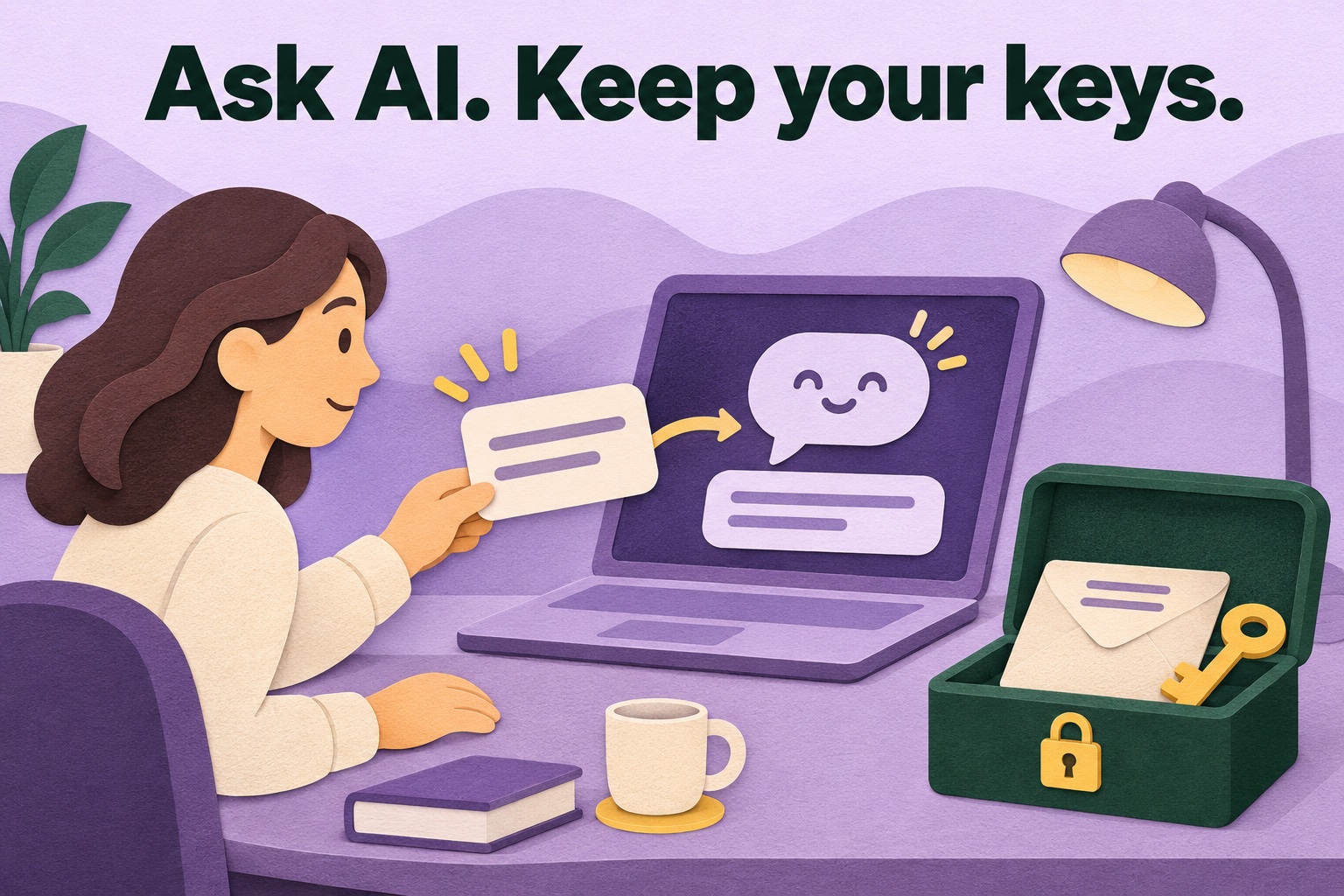
Share the question, not the key
An AI chatbot produces answers using your input and other information available to the service. That can help with crypto: explaining an error in plain language, comparing unfamiliar terms or creating a checklist. You do not need to give it access to your money for any of those tasks.
A recovery phrase and private key are different from an ordinary wallet question. They can provide control of your crypto. MetaMask therefore warns against sharing them with anyone. A chatbot does not need those secrets to explain a network fee. Keep passwords and one-time login codes out of the conversation too.
Start with one specific question. Then check the answer, instead of immediately sharing a whole collection of screenshots and documents that the explanation may not require.
Turn your screen into a focused question
A screenshot can reveal more than the message: your name, balance, wallet address, email and a QR code. A public wallet address is not a secret key, but on a public blockchain it can help connect transactions to a person. Share only what the explanation actually requires.
Retyping is often better than uploading a whole screen. Copy only the error wording, without codes, names or addresses. If an image is necessary, make a separate copy with unnecessary information actually removed or covered opaquely. Inspect that copy before sending it. A slight blur is not a reliable way to hide something.
A fictional example: Noor wants to understand fees
Noor sees a failed transfer and wants to know why. She initially considers uploading her entire wallet overview. Then she notices her balance and a QR code on it. Instead, she types only the general insufficient-network-fee message and names the network, without sharing her address.
Her question becomes: “Explain what this message could mean. What should I check myself? Use an invented example. Do not ask for passwords, private keys or recovery phrases.” Noor uses the explanation as a starting point and compares it with official wallet documentation. She does not let AI send or sign anything.
Private sounds reassuring: check the conditions
How an AI service stores or uses input depends on the service, account and settings. Do not assume one rule covers every product. The UK NCSC advises keeping sensitive information out of public AI services and understanding their terms and privacy policies.
A setting that reduces data use does not make a recovery phrase appropriate input. Separate harmless-looking details can also combine into an identifiable financial picture. Use “wallet A” and an invented amount when your real details add nothing to the lesson. Ask for an explanation, not an assessment of your entire financial life.
If you have already shared a secret
Stop sharing further information. Deleting a conversation does not prove a key is no longer available anywhere. Treat a shared recovery phrase or private key as potentially exposed and use an independently opened official wallet source to find suitable recovery and security steps. Do not follow an unsolicited “rescue service”.
AI can help you formulate a question and understand it faster. The benefit here is saving time without handing away control. Practise these decisions with our free quizzes; no real wallet or money is needed.
Original sources & further reading
- NCSC — sensitive information and AI prompts
- MetaMask — recovery phrases, keys and passwords
- Ethereum.org — public ledgers and privacy
Sources checked on .