Getting Started
Bought an NFT? Copyright does not automatically come with it.
You see a beautiful digital image and a button to buy its associated NFT. What can you actually do with that image afterwards? Your wallet alone does not answer the question. Understand the token, the file and the usage rights before you pay.
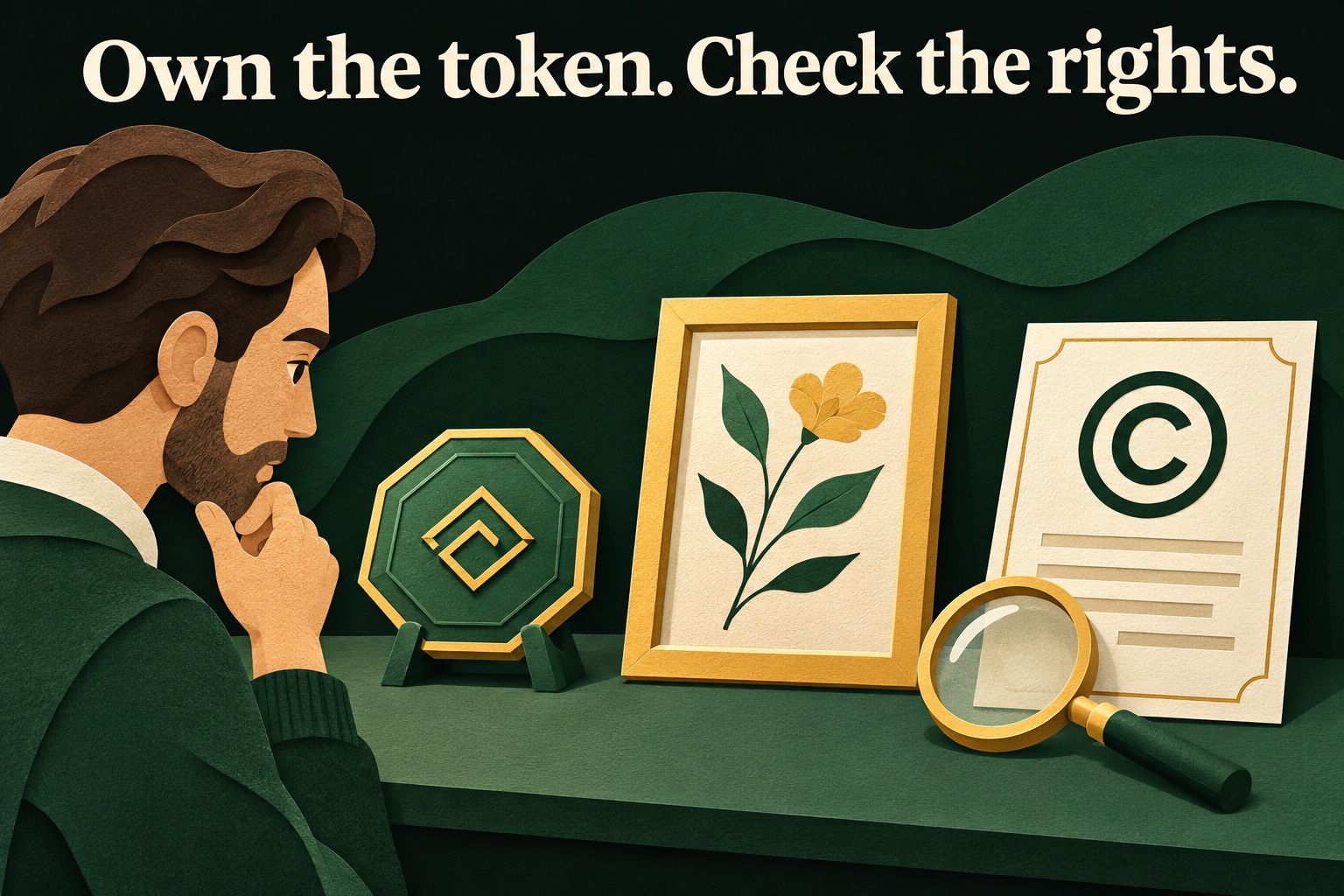
Three things that can look like one
An NFT is an individually identifiable token on a blockchain. It can be associated with artwork, a collectible or an access pass. The record shows which wallet holds the token. That does not automatically make it a contract transferring every right in an image.
Separate three components: the token, the digital file and permission to use that file. WIPO explains that an NFT often refers to information or a file stored elsewhere. Creative Commons clarifies that buying the token does not automatically transfer copyright in the associated work.
Permission to use is different from copyright ownership
Copyright concerns rights in creative work, such as permission for certain copying and distribution. A licence describes the uses the rightsholder allows and their conditions. A valid separate agreement may transfer rights, but a buy button alone does not establish that this happens.
One project might allow personal use while restricting commercial use. Another could offer broader rights. Read the actual terms for the collection concerned; a rule attached to one NFT does not automatically apply to all others. A higher token price does not expand those rights.
A fictional example: Amir wants to make T-shirts
In a completely invented example, Amir buys an NFT associated with a bird illustration. He wants to print the bird on T-shirts and sell them. The project page says only that holders may display the illustration personally. That does not clearly authorise his shop plan.
Amir therefore asks the rightsholder about written commercial terms before ordering shirts. A friend who can download the same image does not thereby own Amir’s token. Equally, Amir’s token does not prove that he can control every use of the artwork. These are different rights.
Check who can grant the permission
A blockchain record can exist even when the seller has no permission from the original creator. Verify the creator and collection through an independently found official source. A familiar logo, high price or polished profile cannot replace that check.
Keep the terms attached to your purchase, including their date and version. Check whether rights change when you sell the token, whether attribution is required and whether particular uses are restricted. Uncertainty is a reason to ask for clarification before proceeding, rather than assume permission.
Where will the image remain?
The token and its associated file do not have to be stored in the same place. Check where the image lives and how you can retain access if a website disappears. A functioning blockchain record is not, by itself, a promise that every external link will work forever.
Some creators share work under an open licence or CC0. Others may then have certain rights without owning the NFT. That does not mean exclusivity for you. Consider what actually matters to you: a collectible, access, usage rights or supporting a creator. None guarantees a higher future resale price.
A simple check before buying
Ask who created the work, which token you receive, where the file is stored and which rights are documented. Match those answers to your intended use. Local law and additional agreements may matter for a specific commercial project; this explanation does not replace that assessment.
You do not need to buy an NFT to learn the distinction. Our free quizzes let you practise decisions about digital ownership. Understanding what you receive helps prevent paying for an expectation that the terms do not deliver.
Original sources & further reading
- Creative Commons — NFTs and copyright
- WIPO — NFT files and copyright
- Ethereum.org — NFTs and their uses
Sources checked on .