Getting Started
You can vote. But who really decides in a DAO?
“The community decides.” That sounds as though everyone has equal influence. Yet one participant can outweigh a whole group. And winning a vote does not always mean anything has been carried out. Understanding these two differences helps you judge what your vote actually means.
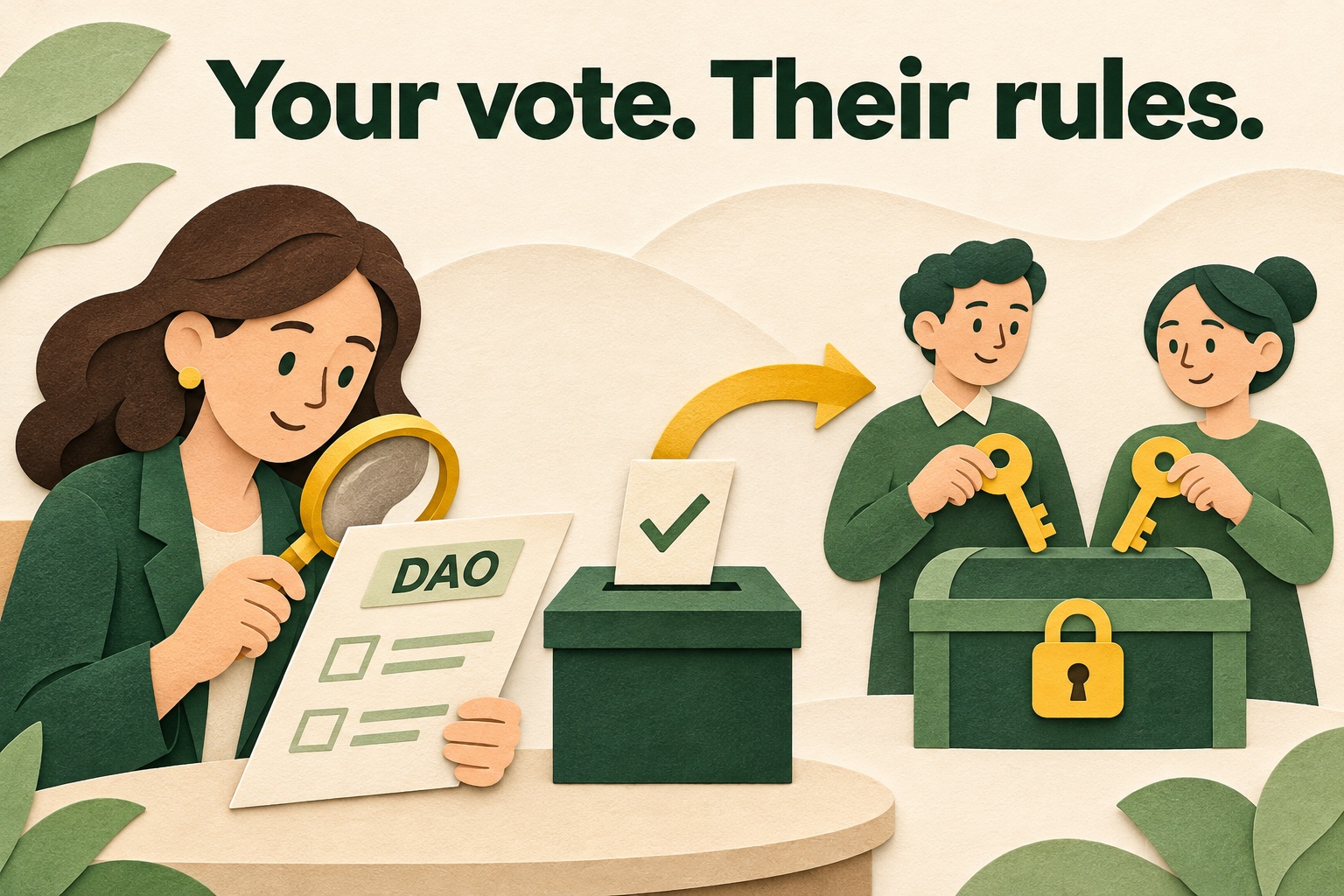
An online association with its own rules
A DAO is a group that organises shared decisions online, often using blockchain technology. The initials stand for decentralised autonomous organisation. Imagine people deciding which projects receive money from a shared fund. The name alone does not tell you who can ultimately move that money or change the rules.
Think of an association. You would want to know who belongs, who can vote and who carries out a decision. A DAO may automate some steps with software. Other steps may depend on people with special powers. Start with the actual process, rather than the word “decentralised” displayed on a website.
One person does not always mean one vote
Imagine a completely fictional group called Haven gives voting power according to tokens. Eight participants have ten votes each. A ninth has one hundred votes. If that person votes against and the others vote in favour, the larger group of people does not automatically win. The agreed weighting determines the result.
Other groups can choose different rules. The voting platform Snapshot, for example, supports different ways to calculate voting power. Ask which rule applies to this particular proposal. A long membership list says little by itself about how influence is distributed. Voting power also does not promise profit, company shares or a payout.
A green majority is not enough
A group may require a minimum level of participation, called a quorum. Suppose Haven requires one hundred participating votes, but only forty count. Even if thirty of those support the proposal, the minimum has not been met. The percentage in favour does not tell the whole story.
Check which votes count, when voting closes and which other conditions apply. A screenshot showing “75% in favour” may be useful information. It does not, by itself, prove that a proposal has validly passed. Assess the result using the rules set beforehand, rather than the most enthusiastic comment underneath it.
Who actually carries out the decision?
Some systems connect a successful proposal to an action that software can execute. Others depend on designated people to implement the decision, for example by jointly signing a transaction. There may therefore be further steps or waiting periods between “passed” and “executed”.
Ask who can perform that step, whether anyone can intervene and where execution can be checked. Suppose Haven approves paying for a translation. The voting result does not automatically prove that the translator has already received the money. A decision and the action following it are separate things, even when the interface presents them together.
Participate without taking unnecessary risks
Start with documentation and completed proposals; you need not buy anything to study how the process works. Check how eligibility is determined too. Some votes use holdings recorded at an earlier point in time. Receiving tokens today therefore does not automatically qualify you for a vote that has already opened.
Reach a voting service through an independently checked route. Read what your wallet actually requests. Signing a choice differs from allowing a service to spend tokens. If an unexpected spending permission appears, stop and verify it. The word “Vote” at the top is not evidence that every request underneath is harmless.
Three questions that help you judge participation
Pick an existing proposal and try to answer three questions without making a transaction: how is influence distributed, when is the decision valid and who implements it? If an answer remains unclear, treat it as missing information. A promise of “community ownership” should not be allowed to fill that gap.
This helps you assess participation before handing over money, information or permissions. Our free quizzes provide more practice with everyday decisions. The aim is not to vote everywhere, but to understand what you might be joining and which powers your participation does and does not give you.
Original sources & further reading
- Ethereum — DAO decisions and execution models
- Snapshot — Voting power and eligibility
- Snapshot — Voting strategies
- OpenZeppelin — Governance conditions and execution
- MetaMask — Token approvals and permissions
Sources checked on .